نرفع درجات من نشاء وفوق كل ذي علم عليم
All praise belongs to Allah, the Most High, who has gathered us in such a blessed assembly, one that even the angels would long to be part of.
إذا مررتم برياض الجنة فارتعوا “When you pass by the gardens of Paradise, benefit from them fully.” Blessings and peace be upon the greatest of callers, who invites us to Paradise with these words, and upon his Companions.
Dear brothers in faith, respected teachers and cherished students, like an ant carrying a load larger than itself, you have shouldered the heavy weight of a sacred trust.
The madrasa is a tunnel through time that reaches all the way to Bab al-Salam, a refuge for the brave who swim against the current in an age when Western diplomas are placed on a pedestal.
It belongs to the modern heirs of that longing which once lived in scholars like Ibn Shihab al-Zuhri, who forgot everything of this world once they sat with their books at the lectern.
Unlike the walls of faculties, which suffer from witnessing scenes of unbelief at every moment, the walls of a madrasa are unshakable fortresses of Islam. They cannot put into words the delight they feel at hearing, every second, “Nasara-yansuru, qala Allah wa qala Rasulullah.”
The madrasa is a gateway of reunion, where, with the cemetery beside it and the centuries-old plane tree before it, the transient meets the eternal, this world meets the Hereafter, and the past meets the future.
It is both the owner and the heir of a civilization that Sinan built with marble, Yunus with poetry, and Mevlana with love.
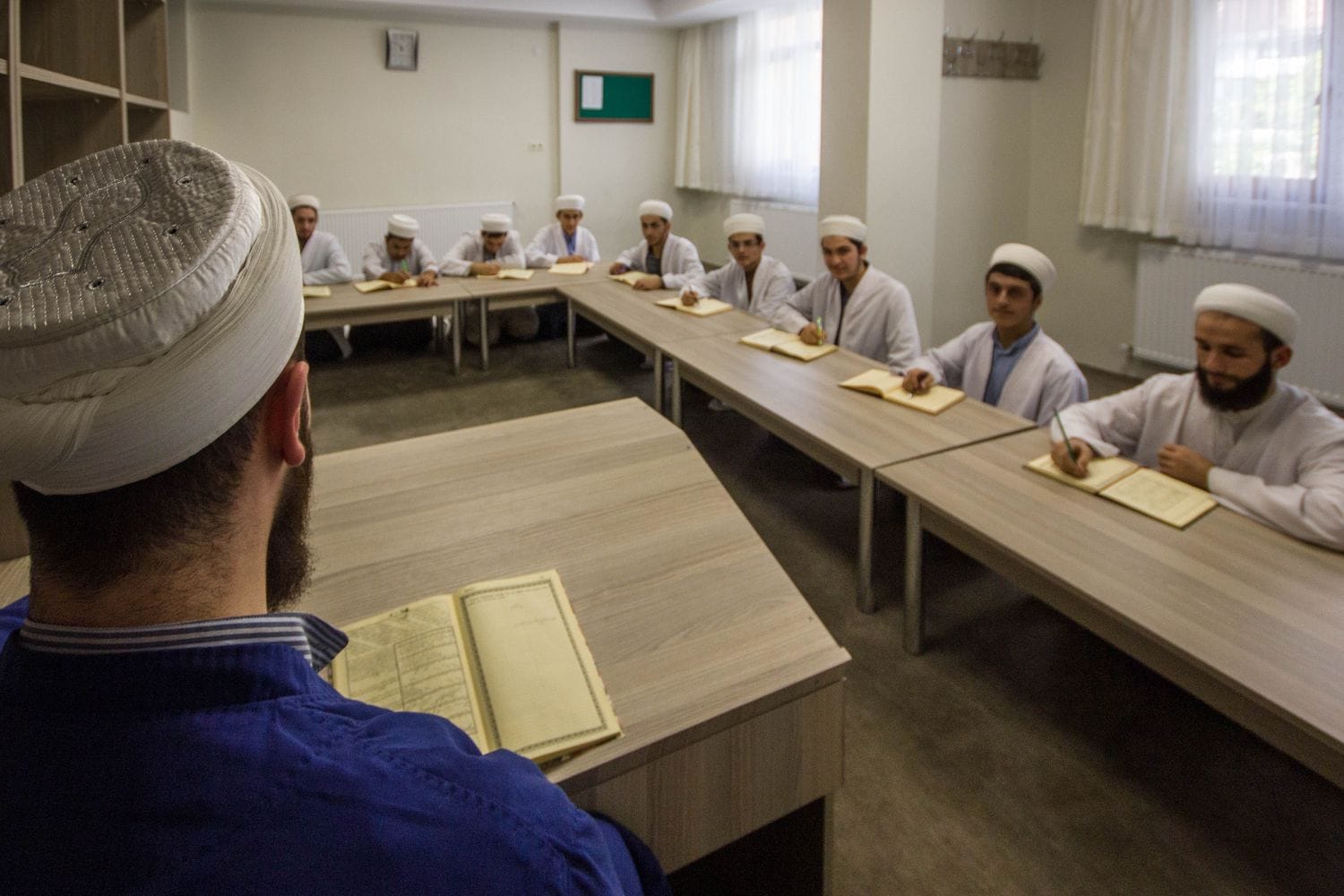
The books on the lectern are from ancient times. They are the works of men like Imam al-Bukhari, who, unlike those who wrote while in a state of impurity, made ablution seventeen times in a single night while compiling his book, because in his illness he would not touch the page without wudu. There is sincerity in their ink and in their pages. The turbaned scholars you see here are the faithful successors of the Rabbani scholars who said, “Heads may be given, but never the turban.”
With the sight they present, they resemble the angels sent down to the turbaned lions of Badr, who were reinforced by three thousand and then five thousand. Because they are always ready to die for their cause, they carry their white shrouds above their heads at all times. The tender children who, while their peers are at play, engrave Mushafs as tall as themselves into their memories are the remnants of the Mus’ab ibn ‘Umayr of the Makkan period. In the words of Fudayl ibn ‘Iyad, “They are the bearers of the Qur’an and the standard-bearers of Islam. They are too honored to be touched without wudu, and too noble to be spoken over without permission.”
They are the men of revival and the hopes of the Ummah, as announced in the glad tidings of our Master, Mahmud Efendi (may Allah sanctify his secret): “Mulla Mahmud, if you heed what I say, people like the Companions will rise from these madrasas.”
They are the Jesuses of the future, dedicated to Allah by mothers like Maryam. They are peerless beings whom Allah swears by in the Qur’an as “those who recite the Reminder.” For they study and teach not to sustain themselves, but to sustain Islam, taking light and giving light.
An unmatched loyalty to Allah and His Messenger lives in their hearts. Yet in an age when everything material is held dear, being condemned to loneliness has become their most telling trait.
In our world today, Islam is wrongly portrayed by enemies from within and without. Correcting this, and reviving and rebuilding it anew, is possible only through the teachers, heirs of the Prophet, who have received madrasa education and training, who have embraced the ancient ideas and adapted them properly to their age. Therefore, if the place where our religion was fully practiced and its core concepts established was the Suffa School in the time of our Prophet (peace be upon him), then today that place is the madrasas. Our Master, Mahmud Efendi (may Allah sanctify his secret), tied the standing of Islam and the Ummah to the madrasa, gave us the glad tidings that religion will spread as long as we protect the madrasas, and said: “If every neighborhood had a madrasa for girls and one for boys, Islam would prevail, by Allah’s leave.” The Fatihs, the Yavuzs and the Sinans are the mirror of the madrasas. The scholars, sages and rulers of today are the mirror of today’s schools.
Dear brothers in faith, who are gathered here in the hope of finding in this assembly the sun they have lost! With all our being we affirm that truth, though it may be hidden, never dies and never vanishes. The journeys of knowledge undertaken by all the conquerors of love who aspire to rediscover the truth lost for centuries pass through the road of the madrasa, just as they did for Ibn Battuta, Ibn Khaldun and Ibrahim Hakki.
“Only the knowing can appreciate the worth of true insight;
only Luqman can understand the wisdom of my verse,”
I say, and I entrust you all to Allah. With respect, I kiss the hands of our dear teachers, mothers and fathers, who embraced us thorns and all and raised us, and I greet you all with reverence.
Mahmud Eren